
.jpg)
The hardest question in performance science used to be what does the evidence say? Today it is a sharper one: what do you do before the evidence has anything to say at all? Technology now moves in weeks and months. The literature still moves in years. For practitioners working with athletes, and for anyone weighing up the new wave of AI sports nutrition apps and performance technology tools promising to change how athletes perform and recover, that gap is no longer academic. It is a daily condition of the job.
Phronesis is the Hexis journal written from inside that gap.
The Meaning of Phronesis
Phronesis means practical wisdom: the judgement to act well in particular situations where fixed rules and finished evidence run out. It is Aristotle's word for the kind of knowledge that comes from experience and is exercised in the moment, the counterpart to the finished, universal knowledge of the textbook.
Aims and Scope
The defining challenge of our field is no longer only what the evidence says. It is how to act well when the evidence cannot arrive in time. Phronesis is written for practitioners who cannot wait for the evidence to catch up.
The journal sets out to:
- Think openly about the science, technology and practice of human performance, at the pace the field actually moves.
- Give practitioners and athletes a way to judge what they cannot yet prove — a discipline for weighing direction, evidence and trust when certainty is not on offer.
- Lead by producing the science, not merely citing it, and stay transparent about where it stands.
Phronesis focuses on the intersection of human performance science, nutrition, behaviour change and technology. It favours essays and applied analysis as well as primary research: bodies of work that reason through hard problems, connect what the science establishes to what practice requires, and examine a field now being reshaped. It is written for the people doing the work, the practitioners and athletes, and it welcomes contributions that advance the infinite game.
Issue 1: There is Only Ahead and Behind
The first issue discusses the problem the whole journal exists to address, and gives it a shape.
Diffusion of innovations describes how a new idea or tool spreads through a population: innovators first, then early adopters, an early and a late majority, and finally the laggards (Rogers, 2003). Adoption, in Rogers' account, runs ahead of proof. Early adopters move on signals other than completed evidence, which is precisely why they are early.
Now lay the evidence curve over the adoption curve.
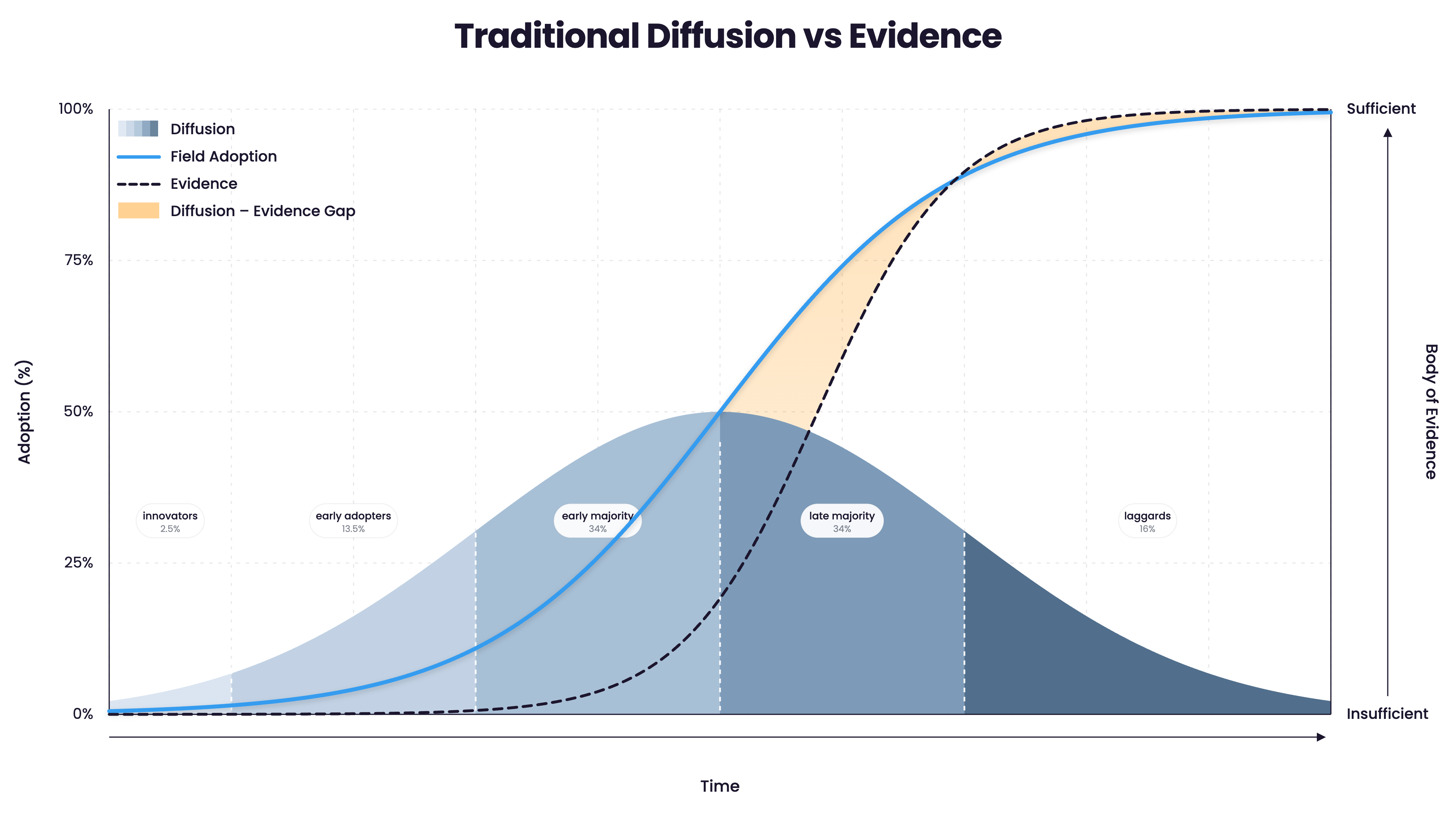
Figure 1. Diffusion vs Evidence. Field adoption and the body of evidence advance roughly in step; the gap stays small (adapted from Rogers, 2023)
In a slow-moving field the two curves stay roughly in step. By the time the majority adopts, the evidence has more or less caught up. The gap exists, but it is small and it closes.
That is not the field we operate in anymore.
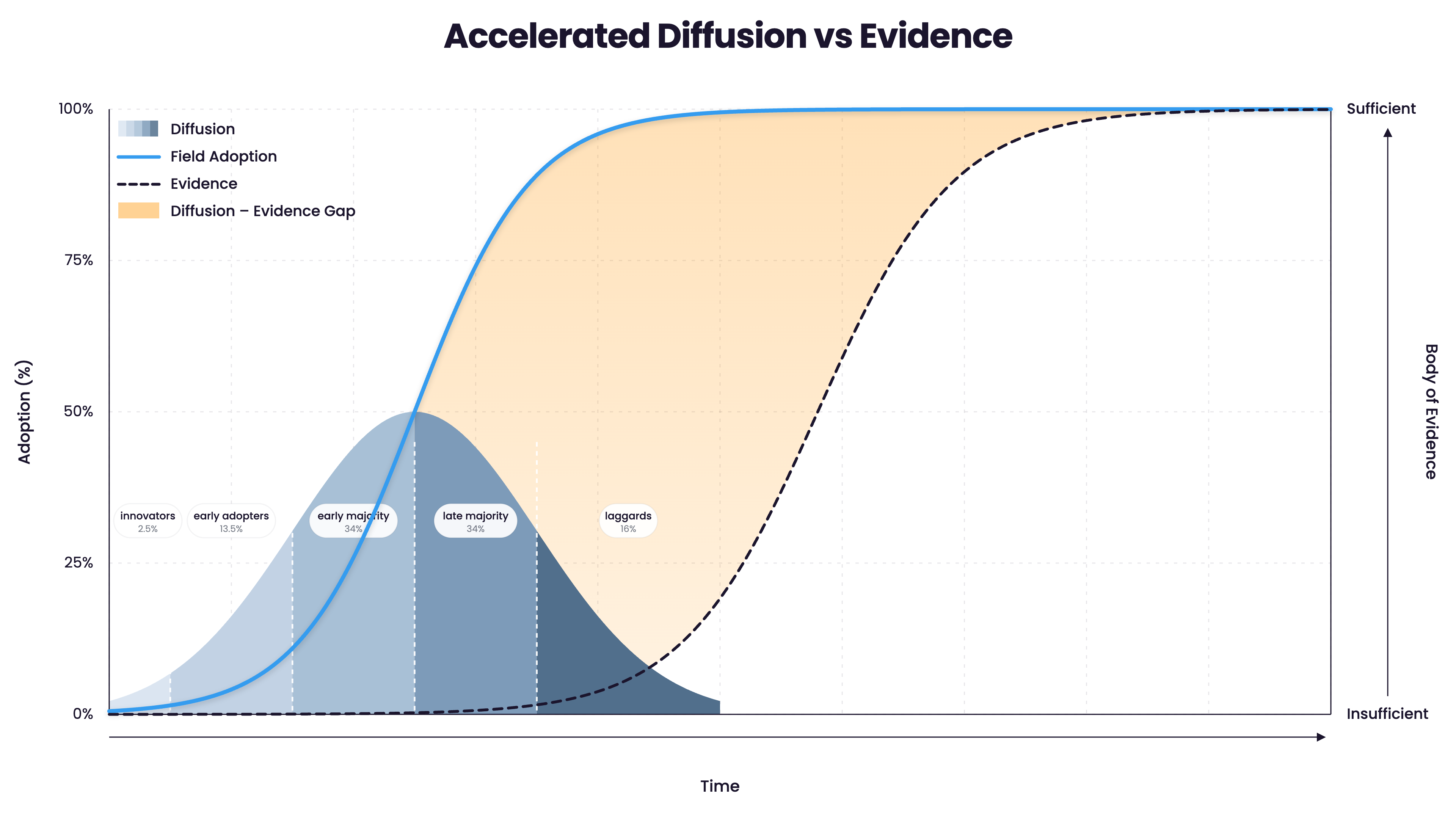
Figure 2. Accelerated Diffusion vs Evidence. Field adoption races ahead at consumer-technology speed while evidence stays bound to the publication cycle, opening a large, persistent gap (adapted from Rogers, 2023).
The two curves decouple when adoption accelerates to the speed of consumer technology while the evidence curve stays bound to the publication cycle. The majority has adopted, moved on, and adopted again before the first robust study lands. The shaded region between the curves is the gap practitioners and athletes now live in. It is where AI sports nutrition tools, wearables and new performance technology reaches athletes long before the trials that would validate them have been designed, let alone published.
As a result, when a sports nutrition platform or an AI performance tool reaches the field faster than the evidence can follow, "wait for the peer-reviewed study" stops being a usable decision rule. Practitioners need a way to weigh direction (where the science is plausibly heading), evidence (how much is actually established), and trust (who is making the claim, and on what basis), and to act before the gap closes.
Why This Matters for Sports Nutrition, Performance Technology and AI Tools
If you are a coach, dietitian, sports scientist or performance lead, you are already making these calls. You are deciding which sports nutrition app to put in front of athletes, which wearable signals to trust, and which features to ignore, usually without a settled body of evidence. The field rewards those who judge well under uncertainty, not the laggards who hold out for publications that land too late.
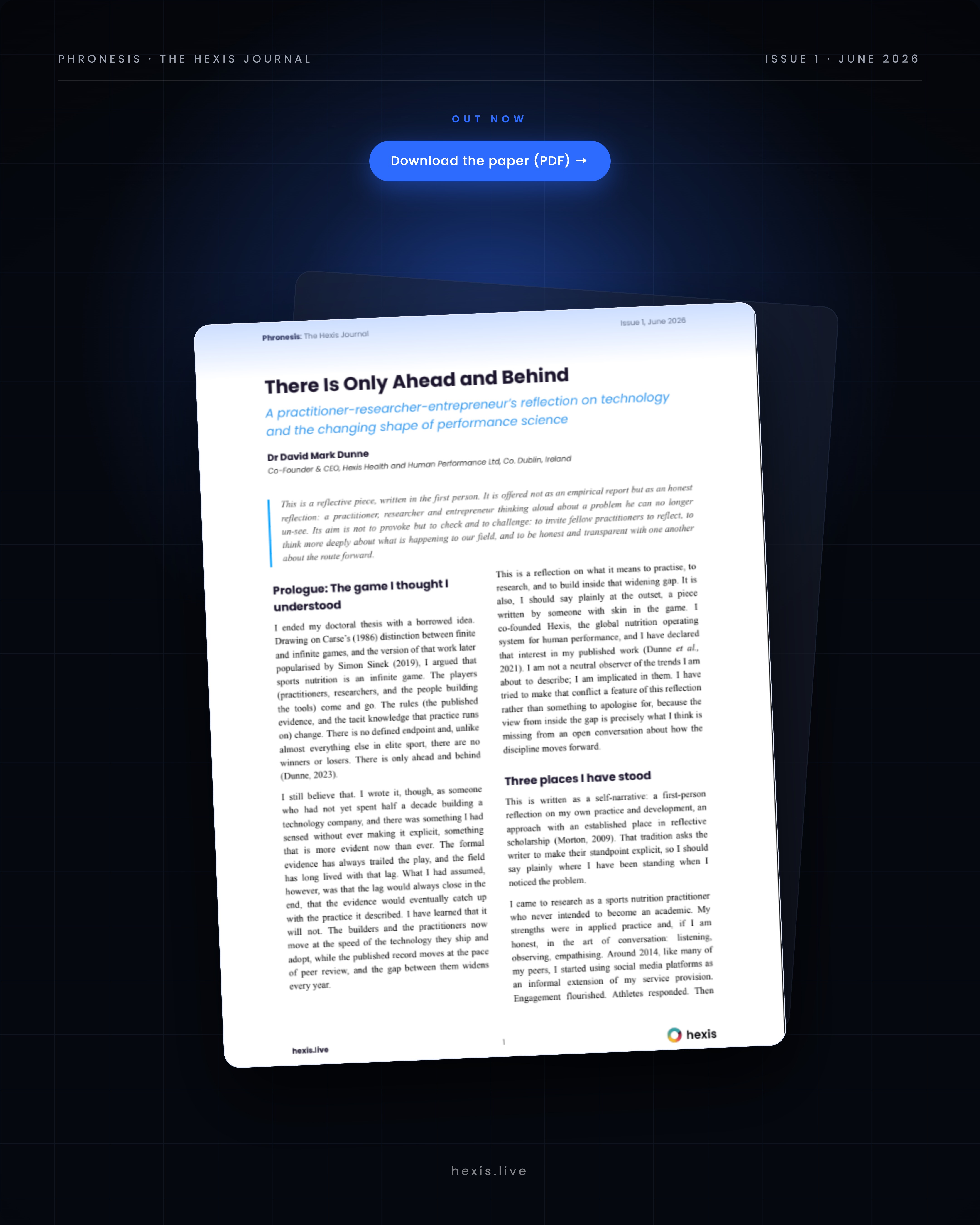
Read Issue 1
There is Only Ahead and Behind: A practitioner-researcher-entrepreneur’s reflection on technology and the changing shape of performance science (Dunne, 2026).
Reference
Rogers, E. M. (2003). Diffusion of innovations (5th ed.). Free Press.


.jpg)


